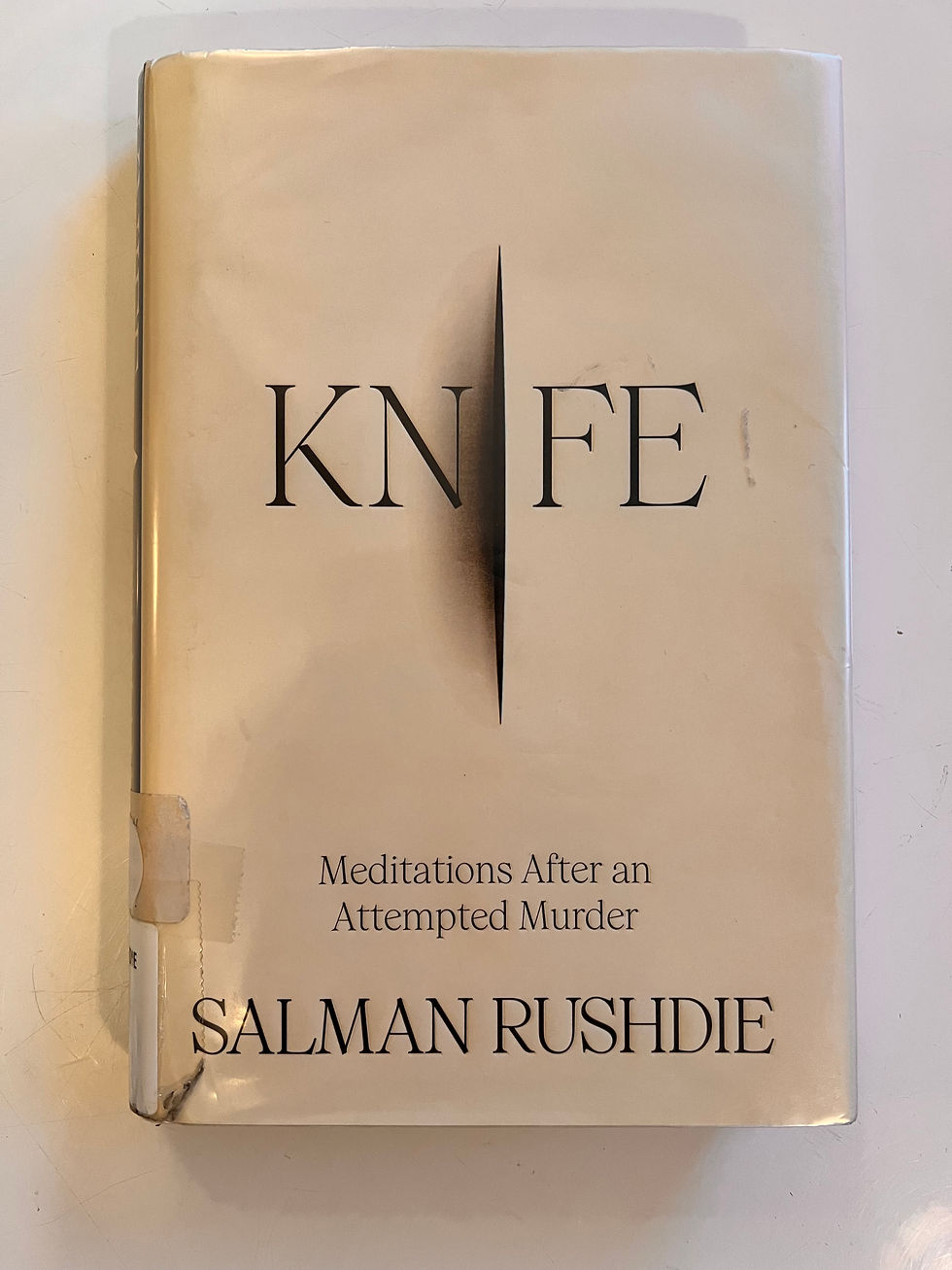
Knife by Salman Rushdie
Salman Rushdie isn’t high up on my list of favorite novelists. I tried to read The Satanic Verses out of curiosity once but gave up after a couple of inscrutable chapters. I made it deeper into Midnight’s Children, but I didn’t connect with that book either and never finished it.
What interests me more than Rushdie’s tales of magical realism are the stranger-than-fiction plot points of his life. I still remember reading a riveting excerpt in The New Yorker from his 2012 memoir Joseph Anton, which recounts his decade in hiding following the fatwa that Ayatollah Khomeini of Iran issued against him. Joseph Anton was Rushdie’s alias, a combination of the first names of his favorite authors: Joseph Conrad and Anton Chekhov.
Knife: Meditations After an Attempted Murder is the follow-up that I’m sure Rushdie wished he’d never had to write. It’s a harrowing account of the summer day in 2022 when a masked, knife-wielding attacker ran onto the stage at a literary event in Chautauqua, New York, where the 75-year-old Rushdie was, ironically, about to give a talk on free speech. He was stabbed 15 times in the face, neck, torso and hand, and only through quick treatment by first responders and trauma surgeons did he survive.
The attack left Rushdie blinded in one eye. It also brought the three-decade-old fatwa, spurred by the publication of The Satanic Verses in 1988 and accusations of blasphemy by some Muslims, immediately back into the international spotlight. His attacker, whom he never names in the book, was a 24-year-old New Jersey man who was accused of carrying out the attempted assassination after becoming immersed in Hezbollah-aligned extremist ideology
Knife is Rushdie’s attempt to come to terms with the violent assault against him, both physically and emotionally. I found it gripping and read it in a day, pulled in by the searing first paragraph.
I never saw the knife, or at least I have no memory of it. I don’t know if it was long or short, a broad bowie blade or narrow like a stiletto, bread-knife-serrated or crescent-curved or a street kid’s flick knife, or even a common carving knife stolen from his mother’s kitchen. I don’t care. It was serviceable enough, that invisible weapon, and it did its work.
Rushdie is unflinching in writing about his near-death experience and long, arduous recovery. He dedicates the book to the caregivers who saved his life. Yet even someone as famous as he experienced neglect within the healthcare system. He recounts episodes in which doctors made his condition worse by prescribing unnecessary medication or not instructing him when to stop taking a drug. He writes about how vital it is to have an advocate by your side in the hospital, which almost anyone who has navigated the medical bureaucracy can relate to.
Rushdie spends a lot of the book recounting his love story with the poet Rachel Eliza Griffiths, his fifth wife and a woman more than 30 years his junior. They married less than a year before the attack. Toward the end of the book, though, he shifts tone to imagine a jailhouse confrontation with his attacker. The two argue about Islam, with Rushdie needling him for his twisted logic, religious indoctrination, lack of social skills and – in a surreal show of Rushdie's intellectual bravado – his ignorance of the great philosophers.
Rushdie ends the fictional encounter by telling his sullen, shackled attacker that the uproar over The Satanic Verses was at its core a battle between those with and those without a sense of humor. You tried to kill me, he says bitingly, “because you didn’t know how to laugh.”
The writer himself offers a bit of levity here and there in the book, such as when describing particularly invasive medical procedures he endured. I also had to smile when reading his asides about how some of his doctors and therapists were big fans of his work. It felt gratuitous for such a celebrated writer to even include this, but I’m glad their admiration made him feel good and I hope it helped him.
I would never want to inhabit Rushdie’s singular and strange existence, but one thing I do envy is how exceedingly well read he is. Over the course of this short book, he invokes dozens of writers and thinkers, from Ovid to Voltaire, Nietzsche, Kafka and Joyce. I’ve jotted down a few titles he references for my own reading list.
Rushdie laments that while he has written 15 novels, he will always be known primarily for The Satanic Verses. He is aware that many people find the book to be unreadable (another irony — I can't imagine many of his fiercest critics managed to actually read it), though he says he no longer feels the need to defend it. He could have been referring to me when he speaks dismissively of the apocryphal “Page 15 Club,” made up of readers who can’t get past that page number in the novel.
It’s true that Rushdie's fiction may not be for me, but especially after reading Knife, I hope he has the chance to write a lot more of it.


